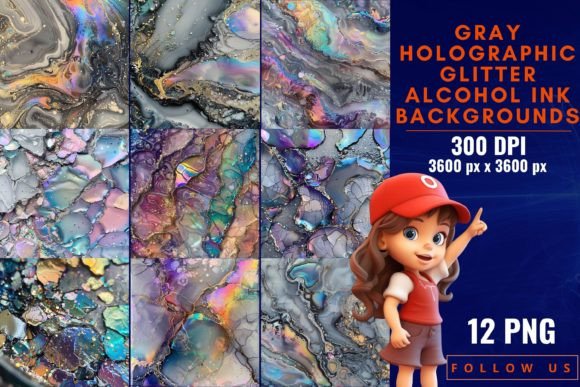
Gray Holographic Glitter Alcohol Ink: A Practical Guide for Creators and Professionals
Gray holographic glitter alcohol ink sits at an unusual intersection. It is neither a bold statement color nor a transparent neutral. Its value lies in how it mediates between light, surface, and surrounding hues. For creators who plan their work around layering, texture, and controlled reflections, this ink becomes a deliberate tool rather than an afterthought. Understanding what it does, when to introduce it, and how it interacts with other materials makes the difference between a predictable result and one that shifts with the viewing angle.
What Gray Holographic Glitter Alcohol Ink Actually Does
Alcohol ink itself is a fast-evaporating, dye-based medium that bonds with non-porous surfaces. Add holographic glitter particles suspended in a gray base, and you get a material that reflects a spectrum of colors while muting the underlying surface. The gray tone acts as a dampener. It reduces the brightness of the glitter without eliminating the holographic effect. This makes it useful when you want shimmer that does not overpower the composition.
In practical terms, the ink deposits a thin film that carries microscopic reflective particles. When light hits those particles at different angles, they fracture into rainbow fragments. The gray base absorbs some of that light, softening the effect. The result is a metallic sheen that reads as cool, subdued, and dimensional. It works well on dark substrates where you want the holographic effect to feel integrated rather than applied on top.
Because alcohol ink is transparent by nature, the gray holographic glitter variant behaves differently on white, black, clear, or metallic surfaces. On a white tile, the gray reads as a faint shadow with scattered sparkle. On black or dark resin, the gray disappears into the background, and only the holographic particles catch the light. On a mirrored surface, the glitter becomes layered with the reflection, creating depth that shifts as you move around the piece. That behavior is worth understanding before you commit to a substrate.
Where It Fits in a Creative Workflow
Integrating gray holographic glitter alcohol ink into a project depends entirely on your timeline and layering strategy. In a resin-based workflow, you might apply it during the pigmentation stage, after the resin is mixed but before pouring. Alternatively, you can use it as a top coat on a cured piece, either by brushing or by dripping the ink onto the surface and letting it spread. The difference in outcome is significant. Mixed into resin, the particles distribute evenly throughout the depth of the pour, creating a volumetric sparkle. Applied on top, the glitter sits on the surface, giving a more concentrated reflective layer.
For those working with ceramic or glass, the ink is typically applied after the surface has been cleaned and primed. A heat gun or torch helps move the ink and activate the metallic properties. The gray holographic effect is subtle enough that it can serve as a middle layer between two more saturated colors. When you apply a deep blue or burgundy over it, the holographic particles catch the light through the top layer, creating a glow that feels internal rather than superficial.
In a professional studio setting, this ink is often used for series work where consistency matters. Because the gray base is less prone to color shifting than clear or white bases, you can reproduce similar results across multiple pieces—provided you control for ambient temperature, surface preparation, and drying time. Documenting those variables becomes part of your workflow, especially if you plan to scale production or offer custom work.
Integration with Other Tools and Materials
Gray holographic glitter alcohol ink interacts predictably with a few common mediums, and unpredictably with others. Knowing which scenario you are in saves time and material waste.
- Resin: Epoxy resin accepts alcohol ink well, but the glitter particles can settle if the resin is too thin. A slower-curing resin gives you more working time to distribute the holographic effect. Stirring gently rather than vigorously prevents air bubbles from trapping the glitter unevenly.
- Isopropyl alcohol: Diluting the ink with 91% or higher isopropyl alcohol spreads the glitter across a wider area and reduces the intensity of the gray base. This is useful when you want a faint holographic haze rather than distinct sparkle clusters.
- Heat tools: A heat gun or mini torch pushes the ink across the surface and also affects how the holographic particles align. Directed heat can create directional shimmer, where the glitter follows the airflow. For random distribution, keep the heat source moving and avoid holding it in one spot too long.
- Application tools: Felt applicators pick up and release ink differently than droppers or brushes. For precise placement of holographic glitter, a dropper gives you control over droplet size. For sweeping washes, a felt pad saturated with diluted ink works better.
- Sealers: UV-resistant sealers are recommended because holographic particles can fade when exposed to prolonged sunlight. A matte sealer will reduce the glitter effect, while a gloss sealer will enhance it. If the piece will be handled, a hard coat sealer protects the ink layer from scratching.
Practical Implementation Tips
If you are incorporating gray holographic glitter alcohol ink into a routine, a few adjustments will save you from common frustrations. First, work in a space with stable lighting. Because the holographic effect is angle-dependent, you need consistent light to judge how much glitter has been deposited. A desk lamp with a flexible arm lets you check the piece from multiple angles as you work.
Second, test on scrap material before committing to the final surface. Alcohol ink does not lift easily once dry, and glitter particles can be difficult to remove if they settle in an unwanted pattern. A test tile or small resin sample will show you how the gray base interacts with your chosen substrate and how the holographic particles behave under your specific heat and dilution conditions.
Third, consider the order of operations in a multi-layer piece. Gray holographic glitter ink works well as a middle layer because the holographic effect penetrates thin layers above it. If you apply it as a top layer, the glitter will dominate the visual field. If you bury it under a thick opaque layer, the holographic effect will be lost. Plan the sequence so that the ink sits where it can catch light without being obscured.
Fourth, store the ink upright and shake it gently before each use. The holographic particles settle over time, and vigorous shaking can introduce bubbles. A slow roll of the bottle redistributes the glitter without aerating the liquid. If the ink has thickened from evaporation, a few drops of alcohol ink thinner will restore its flow without diluting the color density significantly.
Quality Control and Consistency
For professionals who produce work in batches, consistency is paramount. Gray holographic glitter alcohol ink from different batches can vary slightly in particle size or gray depth. Before starting a series, test each new bottle on a small sample. Log the batch number, the substrate used, the dilution ratio, and the heat application method. If a client orders a matching set of pieces months later, that log ensures you can reproduce the same effect.
Quality control also applies to surface preparation. Alcohol ink adheres best to pristine non-porous surfaces. Oils, dust, or residual mold release on resin will cause the ink to bead up or crawl away from certain areas. Wipe the surface with isopropyl alcohol before applying the ink, and avoid touching the area with bare fingers. The holographic particles will highlight any unevenness in the surface, so a smooth substrate is essential for a clean result.
Drying time affects the final texture. Alcohol ink dries within seconds to minutes depending on ambient humidity and airflow. If you want the holographic glitter to remain on top of the dried layer, let the ink dry fully before applying a sealer. If you want the glitter to sink slightly into a resin layer, apply the ink while the resin is still tacky. That window of tackiness is narrow, so have the ink ready before you begin the pour.
Long-Term Use and Storage
Alcohol ink has a shelf life. Over months, the alcohol carrier evaporates even through a closed bottle, thickening the ink and altering how it flows. Gray holographic glitter alcohol ink is especially sensitive because the glitter particles need enough liquid suspension to move freely. If the ink thickens, the glitter clumps and deposits unevenly. Replace bottles that have been open for more than a year, or use a thinner regularly to maintain the original viscosity.
Store bottles in a cool, dark place away from direct sunlight. Heat accelerates evaporation, and UV light can degrade both the gray dye and the holographic coating on the particles. A drawer or cabinet at room temperature is sufficient. If you transport the ink to workshops or client sites, secure the bottles upright to prevent leakage and keep the glitter suspended.
Cleaning tools promptly after use extends their life. Alcohol ink stains synthetic brushes permanently, but felt applicators and droppers can be rinsed in isopropyl alcohol if done immediately. Dried glitter particles are abrasive and can scratch glass or resin if wiped with a dry cloth. Use a soft lint-free cloth dampened with alcohol to clean surfaces where the ink has spilled.
When Gray Holographic Glitter Alcohol Ink Fits Best
This ink is not a universal solution. It performs best in pieces where the goal is controlled shimmer rather than high-impact sparkle. For jewelry, coasters, decorative trays, and abstract wall art, the gray holographic effect adds a professional finish that reads as intentional. For projects requiring bright, saturated glitter, a clear or iridescent base would be more appropriate.
It also fits well in educational settings. Because the gray base makes the holographic effect visible without overwhelming the eye, it works as a teaching tool for demonstrating particle suspension, light refraction, and layering in resin or ceramic work. Students can see how the particles respond to heat, dilution, and surface texture without the distraction of intense color.
For entrepreneurs who sell at craft fairs or online, this ink offers a distinctive option that stands out from common glitter mediums. Listing photos that show the holographic effect at different angles help customers understand what they are buying. A short video clip rotating the piece under direct light converts better than a still image alone. That kind of documentation is easy to produce if you build it into your shooting workflow.
Integrating into a Larger Process
The most effective use of gray holographic glitter alcohol ink comes from treating it as one variable in a controlled system. It is not a standalone material. Its behavior depends on the substrate, the application method, the ambient conditions, and the layers around it. By documenting each variable and testing before production, you remove guesswork and produce results that are repeatable.
Whether you are a hobbyist exploring alcohol ink for the first time or a professional integrating it into a product line, the same principles apply: prepare the surface, control the dilution, apply with intention, and seal for longevity. The gray holographic effect rewards patience and careful observation. It does not demand attention—it reveals itself gradually, which is exactly why it works so well in pieces designed to be lived with and looked at over time.