I'm Sorry, Did I Just Roll My Eyes Out Loud
It starts with a twitch. The corner of your mouth falters, your eyelids take on a life of their own, and before you can stop it, you’ve performed the universal signal of disbelief: the eye roll. But then you compound it with the follow-up statement: “I’m sorry, did I just roll my eyes out loud?” It’s part apology, part indictment, and entirely human. This phrase has moved beyond a mere joke into a cultural shorthand for moments when your inner reaction escapes before your filter catches up. But what is it, really, and why does it resonate so deeply with so many of us?
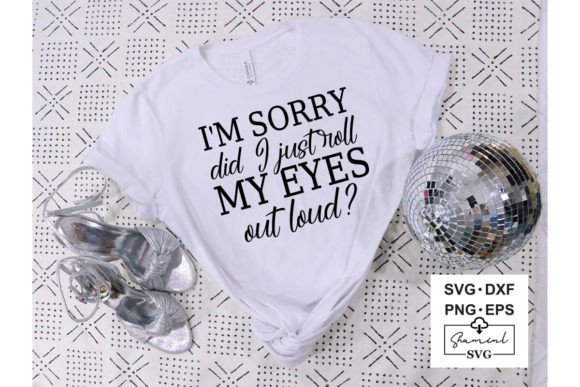
At its core, “I’m sorry, did I just roll my eyes out loud?” is a piece of social commentary wrapped in humor. It’s the verbal equivalent of holding up a mirror to a situation that feels absurd, frustrating, or just plain ridiculous. It acknowledges that you’ve had a visible, nonverbal reaction—and instead of hiding it, you call it out, often disarming the tension in the room. People use it in face-to-face conversations, hang it as a slogan on mugs, brand it on T-shirts, and post it as a caption for memes. The phrase itself has become a tool for marking those moments when polite silence feels dishonest and a full-blown rant feels excessive.
When the Eyes Have a Voice of Their Own
Imagine you’re in a quarterly meeting. Your boss has just introduced yet another “game-changing” initiative that looks exactly like last year’s failed plan—only with a different color scheme on the slide. Your colleague in the corner catches your eye, and you both feel the collective urge. You can’t say what you’re thinking, but your eyes do the talking. Later, over coffee, one of you mutters, “I’m sorry, did I just roll my eyes out loud?” and suddenly the frustration becomes a shared joke rather than a simmering resentment.
This scenario repeats itself in offices, schools, family dinners, and airport security lines. The phrase is a release valve. It creates a moment of connection with people who get it. For professionals in high-pressure environments who are expected to maintain composure, this phrase allows them to signal dissent or exasperation without crossing into insubordination. It’s a way of saying, “I see the absurdity too, and I’m on your side.”
From Boardrooms to Dinner Tables
Different audiences latch onto this expression for different reasons. Consider a parent of teenagers. You’ve just asked your 16-year-old why they left three empty milk cartons in the fridge, and they respond with a shrug and a monotone “I don’t know.” Your eye roll is almost reflexive. Saying out loud that you rolled your eyes out loud transforms the interaction from a power struggle into a moment of mutual absurdity. Teenagers hate being called out, but they appreciate honesty. The phrase levels the playing field without escalating the conflict.
Then there’s the customer service world. A support agent endures a 20-minute call with a customer who insists the computer mouse is not working because they’ve plugged it into the speaker jack. After the call ends, the agent whispers, “I’m sorry, did I just roll my eyes out loud?” to their coworker. It’s a survival mechanism—a self-care ritual that drains the toxicity out of the interaction and reminds them they’re not alone in dealing with daily absurdity.
The Digital Eye Roll
Online, the phrase takes on a life of its own. Social media is a hotbed for eye-roll-inducing content: viral posts full of pseudo-science, political rants that defy logic, or influencers selling “life-changing” products that are clearly just repackaged plastic. Commenting with “I’m sorry, did I just roll my eyes out loud?” serves as a witty, self-aware way to call out nonsense without launching into a heated argument. It’s a rhetorical device that signals your stance while inviting likeminded readers to chuckle in solidarity.
On platforms like Reddit, Twitter, or TikTok, the phrase often appears in replies to particularly tone-deaf statements. It walks the line between playful sarcasm and genuine frustration. For content creators, it can be a hook to start a narrative about a ridiculous experience, using that line as the headline for a story that everyone has lived through at some point.
Why Saying It Out Loud Can Be a Superpower
The real strength of this expression lies in its self-awareness. When you say it, you’re admitting that you had an involuntary reaction—but you’re also asserting control over that reaction by naming it. This does a few useful things:
- It clears the air. Rather than letting the unspoken tension of an eye roll linger, you bring it into the open. Most people don’t know how to respond to someone who admits they just eye-rolled. It forces the other party to either laugh or acknowledge the awkwardness, which almost always reduces conflict.
- It builds rapport. Sharing a moment of mutual eye-rolling (and owning it) creates an “us versus the situation” bond. It signals you’re a person who doesn’t take yourself too seriously, and that you’re willing to be transparent about your reactions.
- It protects your sanity. For anyone working in high-stress environments, suppressing every eye roll and micro-expression is mentally draining. Using this phrase as a verbal exhale allows you to release that built-up irritation before it turns into resentment or burnout.
People also use it as a quiet form of protest. In settings where you can’t openly disagree—a corporate training day, a mandatory webinar, a family gathering with a difficult relative—saying “I’m sorry, did I just roll my eyes out loud?” communicates your dissent to those who understand, without starting a public fight.
When to Hold Back: A Few Honest Thoughts
No tool is perfect for every situation, and this phrase has its limitations. First, timing is everything. If you’re in a sensitive conversation—a mediation, a performance review, a heartfelt apology—blurting out this line can undermine the trust in the room. The person receiving it might feel mocked rather than understood. It’s best reserved for moments when the absurdity is obvious and shared, not when tensions are high and someone’s ego is on the line.
Second, tone matters. Said with genuine amusement and a touch of apology, it’s charming. Delivered with aggressive sarcasm or sneer, it can come across as passive-aggressive or condescending. The same words can either diffuse a situation or escalate it, depending on your delivery. Pay attention to your relationship with the people present. Are they likely to get the joke? If they’ve never used sarcasm in their life, maybe pick a different tool.
Third, overuse wears out the charm. If you say it three times in a single meeting, people will start to see you as perpetually negative. Like any spice, a little bit adds flavor; too much ruins the dish. Reserve it for the moments that genuinely deserve a shared chuckle of disbelief.
Who Gets the Most Out of This Phrase
It’s tempting to think this expression belongs to snarky teenagers or cynical office workers, but its reach is broader. People in industries where they deal with repetitive folly—teachers, healthcare workers, tech support, journalists, retail managers—often adopt it as a coping mechanism. They live in worlds where rules change weekly, customers demand the impossible, and logic sometimes takes a back seat. The phrase gives them agency over their reactions.
Creatives and writers love it because it encapsulates a whole story in one line. You could use it as the title of a blog post about surviving corporate nonsense, or as a caption for a photo of a spreadsheet with a coffee stain shaped like a question mark. It’s a versatile linguistic tool that works as a punchline, a headline, and a social lubricant.
Even introverts, who may struggle to verbally express frustration in group settings, find it useful. If you’re the quiet one who rolls your eyes internally a lot, saying it out loud can feel like a small victory—a signal that you’re present, perceptive, and not afraid to show your hand.
Practical Example: The Meeting That Won’t End
Let’s paint a picture. It’s 4:45 PM on a Friday. Your team is in a meeting that was supposed to end at 4:00. The presenter is going through slide 47 of a 63-slide deck, and it’s a bar chart comparing two almost identical metrics. Someone asks a question that was already answered on slide 12. You feel your eye muscle spasm. Your coworker next to you sees it and barely suppresses a smile. After the meeting, walking to the elevator, you turn to them and say, “Seriously, did I just roll my eyes out loud? I couldn’t help it.” They laugh and say, “I saw it. I was doing the same thing inside my head.” That’s the entire value of the phrase: it turns a shared irritation into a moment of human connection.
Strengths and Subtle Pitfalls
To sum up its practical value: the phrase is strong because it owns the reaction. It’s disarming. It builds camaraderie. It relieves pent-up emotional energy. It’s an icebreaker when people are too polite to say what they really think. And it’s memorable—people will quote it back to you weeks later, which means it sticks in the cultural memory.
But potential pitfalls include misreading the room, coming off as cynical, or using it as a shield to avoid deeper conversations. If you find yourself reaching for this line every time someone shares an idea you disagree with, ask yourself: is it the idea that’s absurd, or my reaction to it? Sometimes the best response is simply to ask a clarifying question instead of rolling your eyes—out loud or otherwise.
Ultimately, “I’m sorry, did I just roll my eyes out loud?” is more than a funny saying. It’s a small but powerful tool for navigating the everyday absurdities that life throws at us. Whether you’re in a boardroom, a living room, or a Twitter thread, it offers a way to acknowledge frustration without losing your cool—and to find a moment of humor in the middle of madness.