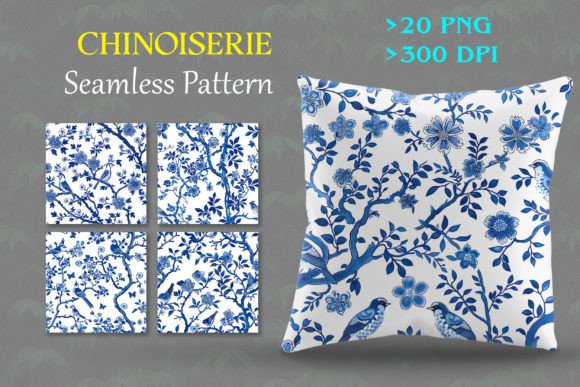
Chinoiserie Seamless Patterns in Design
Imagine a pattern that transports the viewer to an eighteenth-century trading port, where porcelain, silk, and lacquerware converged with European imagination. That is the allure of the Chinoiserie Seamless Pattern—a visual language that blends Eastern motifs with Western fantasy, and it is experiencing a powerful resurgence in contemporary graphic design. For designers seeking to infuse projects with elegance, storytelling, and a touch of exotic nostalgia, this style offers an unexpectedly versatile toolkit.
What Defines a Chinoiserie Seamless Pattern
At its core, Chinoiserie is not a faithful representation of Chinese art but a romanticized Western interpretation. Common motifs include pagodas, blossoming branches, delicate birds, parasols, and stylized floral arrangements, often set against soft, wash-like backgrounds. When rendered as a seamless pattern, these elements repeat infinitely without visible breaks, making them ideal for digital and print applications alike. The result is a design asset that feels both historically rich and refreshingly modern when used with restraint.
Why Modern Designers Are Turning to This Aesthetic
In an era dominated by minimalist and brutalist trends, Chinoiserie seamless patterns offer a counterbalance—an invitation to ornament, detail, and visual richness. They introduce a sense of visual hierarchy through layered compositions, where foreground motifs command attention while background textures provide depth. For branding projects, this means creating a brand identity that stands apart in crowded markets. A luxury tea company, for example, might use a subtle Chinoiserie repeat on packaging and social media to evoke heritage and craftsmanship without uttering a single word.
Practical Applications Across Creative Projects
The versatility of a Chinoiserie seamless pattern extends far beyond wallpaper or fabric. Here are several ways designers are integrating it into their workflow:
- Branding and Logo Design: Use pattern fragments as brand marks or background textures for business cards and letterhead. The intricate lines communicate attention to detail.
- Packaging Design: A full-bleed pattern on premium boxes or product labels instantly elevates perceived value, particularly for cosmetics, candles, or specialty foods.
- Editorial and Print Design: Chapter openers, pull quotes, and section dividers gain character when framed with delicate Chinoiserie borders.
- Digital Marketing and Social Media Graphics: Rotate pattern swatches as Instagram story backgrounds or email newsletter headers for a consistent, recognizable color palette and mood.
- Web and UI Design: Use sparingly—perhaps as a hero section backdrop or hover state accent—to add texture without overwhelming UX design goals.
- Merchandise and Digital Products: Create themed collections for print-on-demand items like phone cases, notebooks, or home decor, appealing to audiences who value modern aesthetics with a classic twist.
Evaluating Quality and Fit for Your Design System
Not all Chinoiserie seamless patterns are created equal. When selecting or commissioning assets for a project, consider these factors:
- Scalability: Does the pattern hold its visual integrity when scaled down for a business card or enlarged for a billboard? High-resolution vector files are essential for professional presentation across media.
- Color Flexibility: The best patterns offer multiple colorways—muted neutrals for subtlety, jewel tones for impact—enabling you to align with an existing brand identity without compromise.
- Composition Density: Decorative yet readable. A pattern that is too busy competes with typography and core messaging; one that is too sparse loses its Chinoiserie character. Balance is key for visual communication.
- Cultural Sensitivity: Approach this style with awareness. It is a Western art historical trope, not a cultural substitute. Use it to evoke a specific design lineage, not to misrepresent. Thoughtful designers acknowledge its origins while applying it to creative projects with respect.
Pairing Pattern with Typography and Color
A Chinoiserie seamless pattern does its best work when supported by complementary design elements. Pair it with clean, contemporary typography—a sans-serif like Helvetica Now or a refined serif like Mrs Eaves—to create tension between ornate and spare. For color palette decisions, draw from the pattern itself: pick out a blush pink or celadon green for headlines, and let the pattern serve as the hero. This approach strengthens visual hierarchy and ensures the pattern enhances rather than hijacks the user experience.
Optimizing for Digital and Print Workflows
In web design and UI design, seamless patterns can affect load times if not optimized. Use tile-friendly formats and test repeatability across screen sizes. For print design, request CMYK files with adequate bleed and check that fine details reproduce clearly at intended scales. Whether you are building a logo design system or a full editorial design layout, having the pattern as a reusable asset in your library streamlines design workflow and maintains consistency across advertising campaigns and presentations.
The resurgence of Chinoiserie seamless patterns reflects a broader appetite for design inspiration that marries history with functionality. For the graphic designer, this is not merely a decorative relic but a strategic tool—one that can differentiate a brand identity, deepen visual communication, and bring a sense of curated elegance to every creative project it touches. When chosen with intention and applied with restraint, it transforms the ordinary into the extraordinary, proving that the most enduring design trends are those that tell a story.